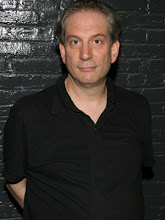
Interview by Brad Balfour
When actor David Rasche came into the room, I knew this was going to be a different kind of interview session just as In The Loop is a different kind of political comedy. The 65-year-old Rasche was supposed to be joined by director Armando Ianucci and fellow thesp Zach Woods to conduct an intimate roundtable with four of us--but because Rasche was early--or on time--for us, our conversation was transformed, much like the shambolic supposedly "secret" committee meeting organized by Rasche's character, the gung-ho American warmonger Linton Barwick (a cross between Dick Cheney and Don Rumsfeld) got transformed and provided a sort of pivotal moment to the film. In a similarly chaotic fashion, Rasche alone spoke with a couple of us before settling down with his fellow Loop-ers and provided some pivotal moments of his own.
Now distributed in the States, the British-produced film debuted at the 2009 Sundance Film Festival and, in New York City, at this year's Tribeca Film Festival. Based on--or rather, taking its cue from Ianucci's smart and snarky look at the inner workings of British politics The Thick of It (kind of like The Office for politicos)--In The Loop follows Cabinet minister Simon Foster (Tom Hollander) through a series slip-ups that gets him involved in the ever-twisting gyre of intrigue that's leads to getting a war started in the Middle East. Sounds familiar...
The film starred some of the series' regulars such as Peter Capaldi (reprising his foul-mouthed communication chief Malcolm Tucker) and American additions such as former Soprano James Gandolfini as a war-reticent General Miller. Within this context, bumbling assistants and loose-tongued associates screw up and screw each other to a dry, droll, parodic effect. The film certainly doesn't view previous British and American administrations as the pinnacle of political achievement.
In light of this summer's health care debate with the right stirring the pot, the film serves as a reminder that the politics of diversion, derision and destruction as expressed by the opposition party goes on. So when a film like In The Loop offers this refreshing and engaging alternative take on the inner workings of the political universe, it becomes a must-see to add perspective.
 Though Ianucci (also the primary writer and producer) with Woods (who plays Chad, a very funny American adjunct) finally arrived, what was supposed to be more of a roundtable, turned into a unusual back-and-forth of banter.
Q: Was that just the roll of the dice that you ended up playing the bad guy, Linton Barwick?
DR:Well you know, they made it a little bit harder in this movie [from the television show]. But that's for Armando [to explain].
Q: How did you see it?
DR:I had a few rejoinders that were excised.
Q: You did it so well. You have this way of doing it so that you don’t come off as just mean.
DR:That sinister thing is there [though].
Q: Is that you or in the script? I can’t believe all the things that Armando threw in there.
DR:It’s terrific eh? Funny as hell. The timing was great; it's global politics. As a matter of fact, I had a friend, Mike Reiss, who was one of the producers of The Simpsons, who said that he thought there are arguably more funny lines in this movie than in any movie he can remember.
Q: But is it too complicated for Americans to get?
DR:I’ve been in tons of audiences like in Seattle [at the film festival]; there were 3,000 people, all Americans, and they just were howling with laughter.
Q: I saw it with critics and they didn’t laugh as much as I imagine an audience would. I was angry at them in a way but I thought it was astounding.
DR:Really? I’m surprised because I have not seen that audience. The only audiences I’ve seen, big or small, have [been with the public].
Q: You don’t even realize some of the lines are really funny until it hits you later; it's so deadpan, and you’re so perfectly deadpan.
DR:It’s really funny, I have to tell you, I’ve been involved in two international projects in the last little bit and it’s absolutely remarkable what we bring to it. Like I did this Brazilian film and people are all saying “Oh, we don’t like you because you did so and so and so and so,” and I said, “What are you talking about?” And the same thing with this; with the British press, the Americans were almost completely ignored and all they could see is the Brits, and now here you’re asking me [about my character]; we see the Americans. It’s funny, what we bring.
Q: Who were you a blend of?
DR:I was going for was a combination of John Bolton and Donald Rumsfeld and Karl Rove and Condoleezza Rice. All those imperious, belittling, condescending, right? Remember all those press conferences? It was like, "Do you really have to act like that? Do you really have to be so belittling and condescending?"
Q: You added the imperiousness brilliantly.
DR:I mean all of them, like David Addington [Cheney's legal counsel and chief of staff]--do you remember him?--they were all so unpleasant.
Q: Evil, evil people.
DR:No, but as unpleasant as a person [can be]. In the hearings, talking over you, not listening, belittling your point of view, remember Condoleezza Rice? “Uh Senator.” Relax, Condi. Anyway.
Q: I was at a Times Square New Year’s Eve with a press pass and John Bolton came to there. No one else had a problem talking to me, Regis, Chris Rock… But Bolton had a phalanx of security; you couldn’t even get 20 feet near him, and it was like, “What the fuck?” And he did not crack a smile the whole time.
DR:They’re so self-important. Same thing with Cheney; he’s doing something that no American politician in the history of the union has ever done, that is breaking the silence [after a new administration has taken over] and starts screaming about you know… And the reason is, “Oh well what’s happening is so important, and I’m so important, I just have to.” Well you know, Dick, I don’t know if you’re that important.
 Q: It’s interesting seeing us filtered through a British cultural lens so that you see Americans in a whole different light.
DR:Oh yes you do. It’s a British film, from a British point of view. Don’t tell Armando I said that. But I think clearly it swung that way… I don’t think he knows it, maybe he does or not.
Q: The most disappointing thing for you about it was that you didn’t get to be in every scene with everybody else, because there are so many good people there.
DR:They had to cut a lot. I used to be but... You’ll have to ask Armando, and I don’t mean to misquote him, but I think he said that he got to the end of editing and knew stuff had to go so he cut his four favorite scenes and then all of a sudden the movie worked. I’m afraid I was in a couple of those scenes. His first cut was four hours.
Q: Did this film feel like it had almost theatrical quality?
DR:I never thought of that.
Q: Without all the locations, it would have been interesting to see it with everything else taken away, and on a stage. Because there’s such smart, snappy dialogue, it reminds me of a lot of those British playwrights, you know [like Alan Ayckbourn] or somebody like that--it does kind of have this beautifully fluid language…
DR:Well the story goes, as Armando will tell you, there was a special guy. No not Tony [Roche, one of the screenwriters]. I’m pretty sure is the guy was Ian Martin who provided, oh, additional dialogue. He specialized in swearing; you know all the crazy [British] swearing? I’m serious, they call this guy up; that was his specialty. When he would say “I’m going to rake your bone and I’m going to stab you in the heart” and all that stuff. “I will hound you to an assisted suicide,” I mean I don’t know which ones. “What are you in a Jane Austen novel?” and all that, a lot of that stuff--specifically that was what he was good at.
 Q: Do you see a difference between British and American humor? Is there something that doesn’t translate well?
DR:Except for people like [play/film writer-director-producer] David Mamet, who I think is the exception that covers both bases--Armando is funny as hell but a lot of his humor is really verbal--it’s in the words, really it’s not that it’s a joke but it’s the combination of words. They’re a little more verbal than us, don’t you think? We’re more situations, sight gags, stuff like that. Well the nice thing about this too is there really aren’t any jokes. There are no like, jokes.
It’s behavior and situation. Although I don’t want to misquote Armando, but I think he said that when he went through the film while was editing and any line, no matter how good it was, if it sounded written, he cut it, because he wanted it to sound like you really were overhearing [them talking].
Q: You can’t lay it on the director, it’s all your fault. There are so many places where you are silent, so it’s all in your look, gesture, the walk forward, or walk over here, or look at this.
DR:Tell him about how wonderful that is.
Q: You got it down with just enough of the restraint--as everybody did in this film.
DR:I’ve been watching those [Bush administration] guys on television for eight years. I mean, just it's appalling, appalling, appalling behavior. And it’s obvious that now that we’ve had six months where we’ve learned you don’t have to do that. We have Joe Biden, we have Barack Obama, and I don’t see it. We have all the cabinet officers, you know, like Leon Panetta [current CIA Director], they’re not insulting.
Q: The Republicans seem like whiny children now...
DR:Absolutely. I think it was the fact that we ended up with the opposite of what they claimed. It seems to me that what we’re learning is that rather than strong men, they were very weak, and when 9/11 happened they all went [weird noise] and they started doing all this kind of extreme stuff because, unlike Roosevelt and those guys who said… "Hi."
They were really weak little boys and they did all kinds of bad things. It didn’t help anything, right? We’re finding out about all this eavesdropping, the effect of this was like, not much.
Q: To what degree do you think we’re living in a democracy?
DR:It’s pretty hard to say that we are anymore. It’s not that, it’s when we find out the influence of the banks and corporate America; we see now that when the banks can throw $25 billion in propaganda you can’t fight it. I was reading there’s a new organization that’s trying to counteract it, but it’s really hard. When they have everybody on TV, the only news stations, it’s like how can you fight it?
It's the same thing with the government; how can government regulators, when Goldman Sachs and all these people hire hundreds and hundreds and hundreds of the finest MBAs from Harvard, Princeton, and Yale to find out how to get around the laws, we don’t have the money to hire people who are smarter than them to keep them from screwing us.
Q: Did you need to read a lot of stuff?
DR:I told you already; I’ve been watching these bastards for eight years on television, shaking my head, thinking, “Oh my god. Despicable.”
Q: Whenever you see politicians they always seem so dry and boring.
DR:Well they all aren’t. Rumsfeld wasn’t; he was a performer, the ultimate performer, who really enjoyed getting up there in front of people. Which was part of his problem that he got carried away and was under the mistaken impression that everything that came out of his mouth was a gold nugget and in fact, I think that was not the case.
Q: I’ve heard of the analogy of politics to wrestling. When you watch wrestling on TV there’s so much tension and conflict but outside of that…
DR:That’s why President Obama, when he frames the argument of abortion as to let us respect each other’s opinions and then go from there, then the whole thing starts from a new spot. It doesn’t start from I hate you and you hate me.
Q: You grew up in Chicago right?
DR:Well I never really grew up; I "enlarged" in Chicago.
Q: Where are you from originally?
DR:It was a joke; you didn’t get it. I said I never really grew up but I enlarged. I was in Belleville, Illinois which is down-state but I spent a lot of time in Chicago.
Q: You’ve got roots on the Obama side, but there’s also classic Chicago politics.
DR:Not only that but Rumsfeld is from Chicago. Oh yeah. I know this personality type. My father was a little like that. Seriously. There’s this kind of stubborn, like that last line where he says “Well there were some pretty scary moments at some point right?” and I said “No there weren’t.” remember that? That could be my father, “No. No. No.”
Q: How would you describe or define patriotism at its core?
DR:The last refuge of scoundrels. Who said that?Jefferson or... I can’t remember. Benjamin Franklin? [Samuel Johnson: “Patriotism is the last refuge of a scoundrel”]